Updated ,first published
A specialist team has located the bodies of four missing Italian scuba divers who died in an accident in underwater caves, Maldives officials said on Monday (Tuesday AEDT).
It is believed the bodies were found deep inside an underwater cave in a Maldive atoll.
“This marks an important milestone in an operation that remains technically demanding, emotionally challenging, and operationally complex,” the DAN Europe divers’ network said in a statement.
The Finnish team arrived on Sunday, after the incident in the Vaavu Atoll, where the Italian divers had been exploring caves at a depth of 50 metres on Thursday.
A military diver taking part in the search died on Saturday from decompression illness, prompting authorities to temporarily suspend the recovery effort which has been taking place in rough weather and sea conditions.
Authorities are investigating procedures ahead of the dive, Mohamed Hussain Shareef, chief spokesperson of the President’s Office of the Maldives, told Reuters.
The body of a fifth Italian diver was recovered on Friday at a depth of about 60 metres inside a cave structure, the Maldives National Defence Force (MNDF) said last week, adding it assumed the others would also be in the cave.
Earlier, Maldives presidential spokesperson Mohamed Hussain Shareef said that three Finnish divers, experts in deep and cave diving, had arrived in the archipelago nation and joined the Maldives coastguard in a meeting aimed at mapping a new search strategy.
The group of five Italian divers is believed to have died while exploring a cave at a depth of about 50 metres in Vaavu Atoll on Thursday, according to Italy’s Foreign Ministry. The recreational diving limit in the Maldives is 30 metres. The body of one of the divers was recovered last week.
Mohamed Mahudhee, a member of the Maldivian National Defence Force, died of underwater decompression sickness during the initial search and recovery effort.
Mahudhee was buried with military honours in a funeral attended by President Mohamed Muizzu on Saturday night. The diver was part of the group that had briefed Muizzu on the rescue plan when he visited the search site on Friday.
Search operations on Saturday involved eight local divers who worked in shifts to locate the bodies, the Italian Foreign Ministry said. Initial teams had already dived to identify and mark the entrance to the cave system where the Italians disappeared. The cause of the deaths remains under investigation.
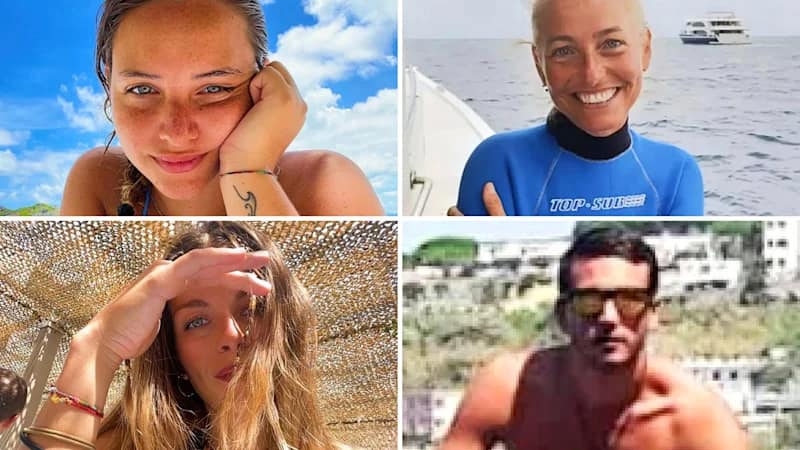
The victims have been identified as Monica Montefalcone, an associate professor of ecology at the University of Genoa; her daughter, Giorgia Sommacal; marine biologist Federico Gualtieri; researcher Muriel Oddenino; and diving instructor Gianluca Benedetti.
Benedetti’s body was recovered on Thursday from near the mouth of the cave. Authorities believe the remaining four had entered the cave.
Montefalcone and Oddenino were in the Maldives on an official scientific mission to monitor marine environments and study the effects of climate change on tropical biodiversity, the University of Genoa said on Friday. However, the scuba diving activity during which the deadly accident occurred was not part of the planned research and was undertaken privately, it said.
The statement also said the two other victims — student Sommacal and recent graduate Gualtieri — were not involved in the scientific mission.
Carlo Sommacal, Montefalcone’s husband and Giorgia’s father, expressed doubts over the accident, saying “something must have happened down there” given his wife and daughter’s extensive experience.
The Italian tour operator that managed the diving trip denied authorising or knowing about the deep dive that violated local limits, its lawyer told Italian daily Corriere della Sera on Saturday.
Orietta Stella, representing Albatros Top Boat, said the operator did not know the group planned to descend beyond 30 metres. That threshold requires special permission from Maldivian maritime authorities and the tour operator “would have never allowed it,” she said.
The dive far exceeded what was planned for a scientific cruise focused on coral sampling at standard depths, Stella added. The victims were experienced divers, but the equipment used appeared to be standard recreational gear rather than technical equipment suited for deep cave diving, she said.
Cave diving is a highly technical and dangerous activity that requires specialised training, equipment and strict safety protocols. Risks increase sharply in environments where divers cannot head straight up and at depth, particularly when conditions are poor. Experts say it is easy to become disoriented or lost inside caves, particularly as sediment clouds can sharply reduce visibility.
Diving at 50 metres also exceeds the maximum depth recommended for recreational divers by most major established scuba certifying agencies, with depths beyond 40 metres considered technical diving and requiring specialised training and equipment.
The Maldives Tourism Ministry said it has suspended the operating licence of the Duke of York pending an investigation.
AP and Reuters