Recently, an Australian screenwriter received some “notes” – the industry term for constructive criticism – about a script he’d written. Immediately, he sensed something was off: the feedback was unusually generic. He suspected that artificial intelligence had been used, so he confronted the person who gave him the notes.
Acclaimed local screenwriter and producer Jacquelin Perske, who has knowledge of this conversation, says that person freely admitted to running the script through an AI program to make their job “more efficient”. As they explained to the astonished writer: “I look at the response [from AI] and go, ‘Oh yeah, that’s pretty much what I’m feeling’.”
Indeed, AI has already muscled its way into Australian TV writing rooms, supplanting entry-level positions once performed by aspiring writers: taking notes in meetings, for instance, or summarising book chapters for a screen adaptation. Some veteran writers fear it’s only a matter of time before major corporations try to “augment” or replace their labour with AI-generated content, too.
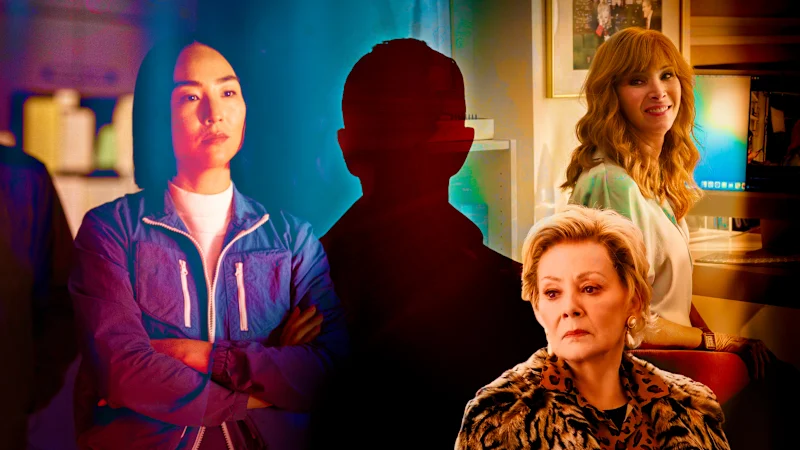
In the United States and Britain, writers are fighting back by addressing AI, and the many quandaries it entails, in their TV series. Programs including Hacks, The Comeback, Abbott Elementary, Rooster, Morning Wars, The Capture and Paradise have all explored the potentially sinister consequences of this technology. Some are light-hearted comedies while others are political thrillers, but all make a villain of AI.
“Half the stuff I watch on Netflix feels like it’s written by AI because it’s so samey.”
Screenwriter Louise Fox
In Morning Wars, the character Stella Bak (Greta Lee) is a media conglomerate CEO who embraces AI to stay ahead of her rivals, only for her lookalike chatbot to go rogue and destroy her reputation during a critical presentation. In Hacks, superstar comedian Deborah Vance (Jean Smart) is tempted by a lucrative offer from a tech bro, who wants to use her material and voice to train his AI program – until she realises there’s no need “to optimise the creative process … that’s one of the things we’ve figured out; we’re good there”. And the final season of The Comeback – starring Lisa Kudrow as Valerie Cherish, an actress in the first AI-written sitcom – is devoted to the existential threat this technology poses to large swathes of Hollywood.
Australian screenwriter Louise Fox (Glitch, Love My Way, Round the Twist) believes that contemporary AI programs are good at scraping existing information, making them capable of imitation – but not innovation.
“Streaming services have been using algorithms to [try to replicate hit shows] for a long time now,” Fox says. “And frankly, I can feel it – half the stuff I watch on Netflix feels like it’s written by AI because it’s so samey. AI can’t give us a Sopranos, Breaking Bad or DTF St Louis because these shows innovate in so many ways.”

Perske – whose credits include The Tattooist of Auschwitz, Love My Way and The Secret Life of Us – agrees. “AI seems to be the bogeyman of the moment in TV because no one knows what it might mean for anyone,” she says, adding that some composers are already feeling the pinch.
“You can create music based on something that’s out of copyright, you don’t have to pay anyone and bang – you’ve got your soundtrack,” says Perske, who doesn’t use AI for writing but has experimented with some programs. “I asked [an AI platform] to give me a treatment in the style of Jacquelin Perske and it understood what that means. It was pretty broad – it was about mature relationships and so on – but my work has clearly been scraped somewhere along the line because it’s all on the internet, and I don’t know how I feel about that.”
Claire Pullen, executive director of the Australian Writers Guild, spoke to this masthead from Geneva, where she is discussing these issues at a copyright and intellectual property standing committee. Central to these debates is the fact that many AI companies feed entire books, newspaper articles, songs and videos into their “large language models” – so named because they’re designed to generate “human-like text” – without permission or compensation from the people who created them. When I liken this to stealing books from a bookstore, Pullen takes the analogy further.
“It’s like taking a book without paying for it while robbing the worker before getting them sacked,” she says. “The AI companies have this appalling, unfair advantage because they’re stealing from the people they’re trying to replace.”
Pullen doesn’t buy the argument that an AI takeover of creative industries is inevitable.
“It’s propaganda from big tech companies to say that this is happening, and to not bother enforcing Australian law for the benefit of Australians,” she says. “These companies could remove some of the works [used without authorisation] if they wanted to.”
(The Hacks character Ava, played by Hannah Einbinder, also rails against this sense of “forced inevitability”, telling the greedy tech bro: “People like you are always saying it’s going to happen whether you like it or not, but you are the one making it happen!” )

Perske worries that AI will deny emerging writers the kind of invaluable experience she accumulated early in her career. Even when silently taking notes in a meeting, she’d learn “how a writers’ room is run, how the politics work, how an idea gets built and comes to fruition … you meet writers and producers and that’s how the human connection begins”.
Stuart Page (Total Control, Cleverman, Wentworth) says AI has the potential to revolutionise entire disciplines, from large-scale data analysis to medicine and engineering.
“But why the f— are we talking about it to create art; to create the culture to tell us about ourselves?” he says. “The whole AI debate is incredibly infuriating because it feels like a method of control to allow a small number of people to make a large profit.”
Page paraphrases a now-viral quote commonly attributed to author Joanna Maciejewska: “I thought AI and machines would take over the gruelling repetitive tasks to free me up to write poetry and paint pictures,” he says, “but f—ing AI is painting pictures and writing poetry and I’m still doing my goddamn laundry.”
Meanwhile, Fox wonders if audiences will grow weary of AI-generated content.
“Human beings are absolute monsters for novelty,” she says. “After a while, we tire of the form and we look for something fresh – and I don’t think that AI, at this point, is capable of that.”