
Washington: The United States will “guard” the Strait of Hormuz and charge ships a fee of 20 per cent of their cargo value to pass safely, President Donald Trump announced, as renewed conflict in the region threatens to spiral out of control.
Trump also said the US would reimpose its naval blockade against vessels entering or departing Iranian ports, the lifting of which was a key part of the Memorandum of Understanding signed in June that is quickly collapsing.
“The Hormuz Strait is OPEN, and will remain OPEN, with or without Iran,” Trump wrote on Truth Social on Monday morning (Washington time). “We are reinstating the THE IRANIAN BLOCKADE [sic], so named because it is only stopping Iran’s ships or customers from entering or leaving.
“All other countries will have fair and open use of the Strait. The USA will be, from this point forward, known as ‘THE GUARDIAN OF THE HORMUZ STRAIT’, but as such, and as a matter of FAIRNESS, will be reimbursed, at the rate of 20% on all cargo shipped, for any and all costs necessary to do the job of providing safety and security to this very volatile section of the World.”
Charging ships to use the strait would be a marked departure from the US’ previous insistence that passage through the crucial waterway should be free and open for all. But Trump has repeatedly floated the idea of imposing a toll, including days after the MoU with Iran was signed.
US Secretary of State Marco Rubio ruled out any attempt to toll the strait as recently as June 24, after the MoU declared that Iran and Oman would be responsible for its long-term management.
“The whole world will be against any mechanism that charges money to use an international waterway. It’s that simple,” Rubio said at the time.
“No country is allowed to charge tolls or fees on an international waterway, that’s existing international law, that’s the way it is.”
Trump’s announcement had an immediate impact on oil prices, with Brent crude climbing more than 6 per cent and trading above $US80 ($115) a barrel by lunchtime in New York.
Most analysts dismissed the notion of a 20 per cent toll or fee as unserious and unworkable, and pointed out it was dramatically higher than the $US1-2 million ($1.45m-$2.9m) service fees threatened by Iran.
Ian Bremmer, president and founder of the Eurasia Group consultancy, noted a 20 per cent fee on shipments of oil would add $US15 to the cost of a barrel.
Iran also signalled its intention to increase its control the strait. State-run media quoted IRGC spokesman Hossein Mohebbi saying the US “must be held accountable” for intervening in the waterway.
“We maintain our sovereignty and control over the Strait of Hormuz with strength and determination, and we will compel foreign powers and their allies to yield to the will of the Iranian nation,” Mohebbi was quoted as saying.
Conflict in the region has escalated over the past week after Iran’s Islamic Revolutionary Guard Corps attacked three vessels in the Strait of Hormuz. Trump declared the ceasefire was “over” and responded with four waves of strikes targeting Iranian radar and surveillance, air defences, drone launch sites and other military infrastructure.
In turn, Iran attempted to strike US military assets in the Gulf using missiles and drones. The IRGC Navy also struck an additional, Cyprus-flagged vessel with an anti-ship cruise missile, and declared the strait was “closed”.
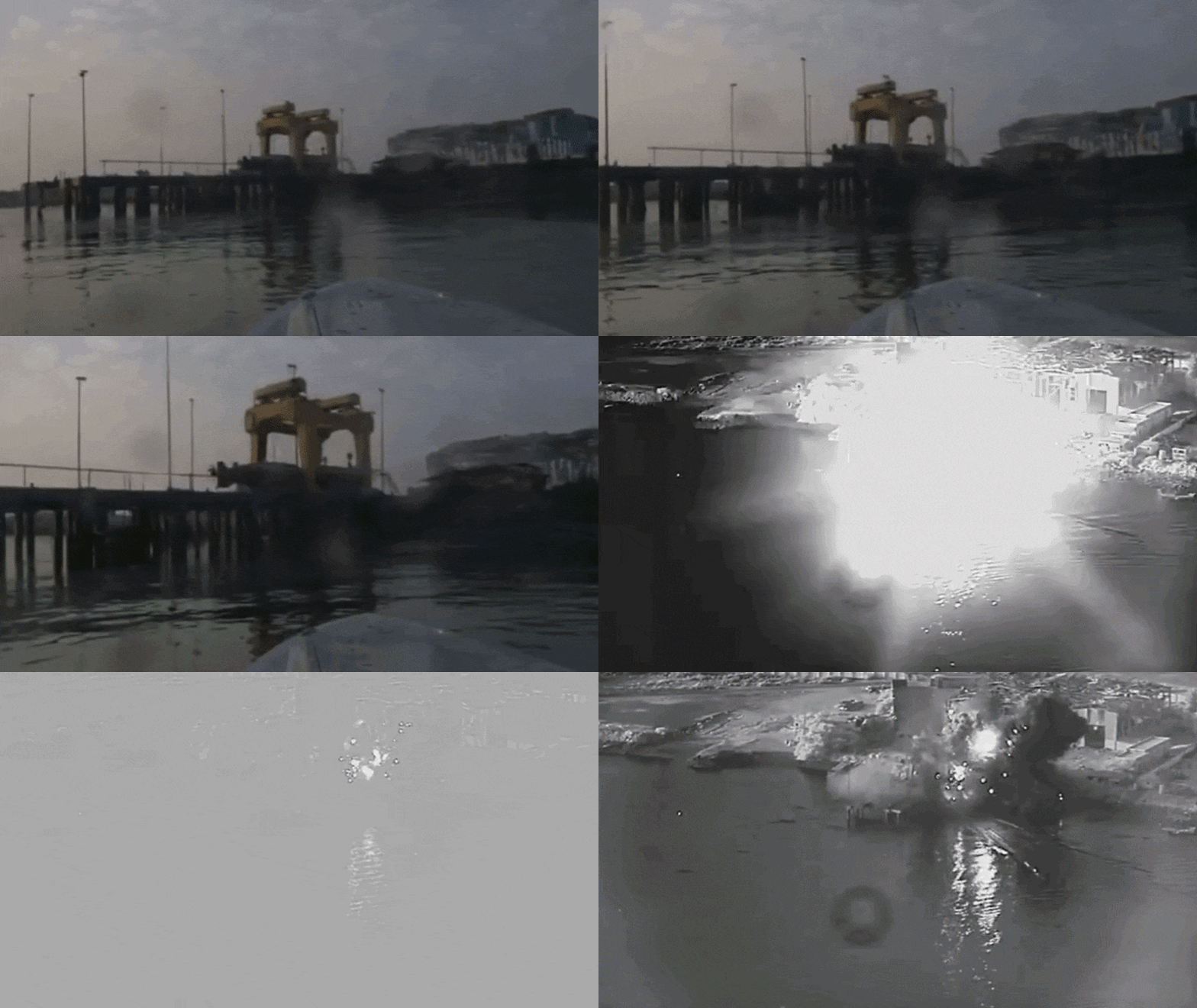
US Central Command said its latest wave of strikes was aimed at degrading Iran’s ability to attack international shipping. It published video of a one-way attack drone hitting a submarine and ship maintenance facility in Bandar Abbas, and said this was the first time US forces had deployed sea drones in combat operations.
Traffic in the strait increased substantially since the MoU was signed in mid-June, and the price of oil plunged. But between July 10 and 12, crossings fell 52 per cent compared to the previous week, according to maritime analytics firm Kpler.
Ship activity on Iranian-controlled and “dark” routes through the strait increased, the firm said, while activity on international waters and the Omani side – where Iran attacked the vessels – had “almost disappeared”.
Appearing on Fox News earlier on Monday, Trump expressed frustration with Iran and foreshadowed his intention to take control of the strait and seek financial reimbursement.
“We guarded the strait for 50 years – more – and we never got paid for it,” Trump claimed. It was not immediately clear what he was talking about.
“They made all the money and the United States was just, not, they wouldn’t – it’s amazing. We guarded it for nothing, and now we’re going to guard it, and we’re going to get paid for guarding it – a lot of money.”
Iran’s defacto control of the strait, courtesy of drone and missile attacks by the IRGC, has become a problematic legacy of the US-Israeli war against Iran, with widespread economic effects for nations that depend on energy from the Gulf, including Australia.
The Financial Times reported on Monday that Unites Arab Emirates port operator DP World was in talks to build a new port and container terminal on the country’s east coast, meaning ships would not need to cross the Strait of Hormuz. Cargo would be trucked to Dubai, Abu Dhabi and beyond.
Get a note directly from our foreign correspondents on what’s making headlines around the world. Sign up for our weekly What in the World newsletter.
 Michael Koziol is the North America correspondent for The Age and Sydney Morning Herald. He is a former Sydney editor, Sun-Herald deputy editor and a federal political reporter in Canberra.Connect via X or email.