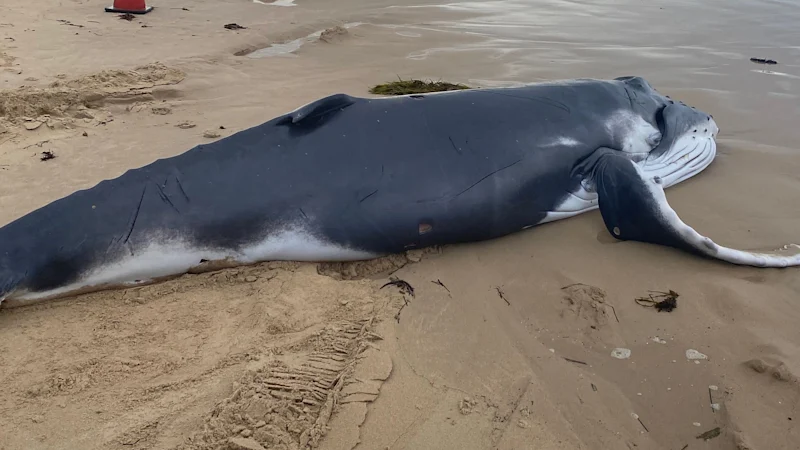

A newborn humpback whale that was stranded on a Sydney beach overnight has died, and the carcass will be tested for H5N1 bird flu.
A member of the public reported the stranded whale on Greenhills Beach in Cronulla about 6.30am on Friday by calling the Organisation for the Rescue and Research of Cetaceans in Australia (ORRCA) hotline.
ORRCA president Ashley Ryan said responders were deployed rapidly but “despite rescue efforts by responding agencies, the calf sadly died shortly after responders arrived”.
The carcass has now been removed from the beach, and Ryan said it would be tested for H5N1, the virulent strain of bird flu that has devastated marine wildlife overseas. It had not yet been decided whether to perform a full necropsy, she said.
Ryan said it was a male humpback whale neonate calf, about 4.5 metres in length. ORRCA was working with NSW National Parks and Wildlife Service, Indigenous ranger group Gamay Rangers and Sutherland Shire Council to complete operational requirements and First Nations cultural protocols.
As a precaution, the NSW Department of Primary Industries and local lifeguards had been notified so appropriate SharkSmart alerts could be implemented.
Ryan said the cause of the stranding was unknown at this stage.
“There are many reasons why whales can become stranded, including illness, injury, separation from their mother, navigational challenges or other natural factors,” she said. “It is too early to determine what led to this particular incident.”
One possibility is H5N1 bird flu, which arrived in Australia last month after having spread to every other continent. In June, sick seabirds blown off course from the sub-Antarctic flyway started to land on the Australian coastline, first in Western Australia, then in South Australia and NSW. A week ago, the virus was detected in a local bird in South Australia.
The virus has devastated seabirds and marine mammals worldwide, and experts warn more than 100 Australian species are at risk of being driven to extinction or to the brink.
Governments have prepared with monitoring and mapping of migratory bird fly routes and have some vaccines in reserve for endangered species.
The flu has also devastated the poultry industry overseas. More than 100 million chickens were killed in the United States when H5N1 broke out, starting in 2022. Egg prices tripled by 2025, which was a significant contributor to inflation.
Members of the public are reminded to keep well away from stranded marine mammals, keep dogs on leads and away from the area, and follow directions from emergency personnel.
Anyone who encounters a stranded, injured or entangled whale, dolphin or seal should immediately contact the ORRCA 24-hour rescue hotline on (02) 9415 3333 or NPWS on 1300 072 757.
Get to the heart of what’s happening with climate change and the environment. Sign up for our fortnightly Environment newsletter.
 Caitlin Fitzsimmons is the environment and climate reporter for The Sydney Morning Herald. She was previously the social affairs reporter and the Money editor.Connect via email.