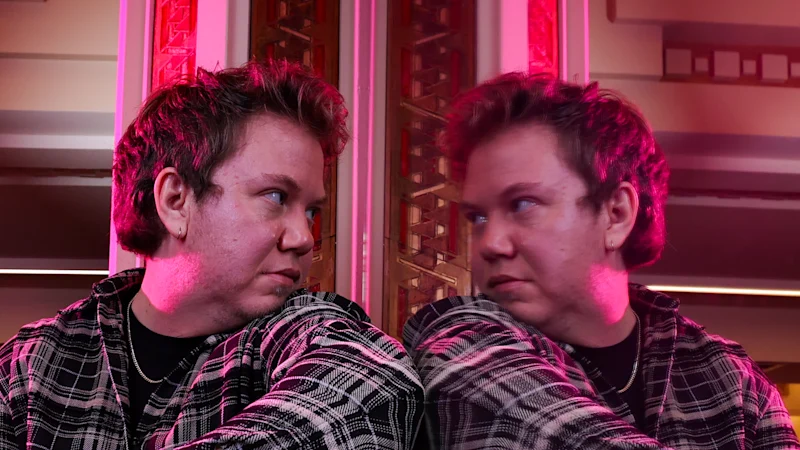

Harvey Zielinski’s first outing as a director is off to a flying start, with his film Sweet Milk Lake making its debut at Melbourne International Film Festival, which unveiled its 2026 program on Thursday night.
Already the film is in the running for two of the richest prizes in the business – MIFF’s $140,000 Bright Horizons prize next month and the $100,000 Cinefest Oz prize in his home state of Western Australia in September.
“It is amazing,” says the 35-year-old of this double dip in the potential prize pool. “It was quite mind-blowing to get that news back to back. That was a good week.”
Sweet Milk Lake is a deeply personal work for Zielinski, who writes, directs, co-produces and plays two roles, as twin brothers Sam and Jake. It was a lot of hats to wear, and it made for an experience unlike any the actor-turned-director had ever had on a film set.
“It was exhausting. I didn’t sit down once for the entire shoot because there’s not a second in the day where you’re not needed,” he says. “That’s very different from being an actor.”
The most difficult days were those in which the twins appear together – not actually, obviously, but through the old-school magic of split-screen photography. Zielinski played each character in turn, shot against a real backdrop to the halfway mark, and a body double appeared on the other half of the shot against a green screen. The whole thing would then flip, and the two performances were later edited together to create the impression that both brothers were present at the same time.
There are only a handful of such shots in the film, but they were, Zielinski says, “very challenging for my brain. I didn’t quite realise how fragmented I was going to feel on those days.”
Fragmentation and doubling are at the heart of Sweet Milk Lake, which revolves around Jake’s decision to return to the country town where he grew up to visit his dying father Lee (Kieran Darcy-Smith). They haven’t seen each other for years – well, technically they haven’t seen each other ever because the last time they were together Jake was Sarah. Lee doesn’t even know his child has transitioned from female to male.
When Jake arrives, he is mistaken for Sam. In a split-second decision, he decides to let the confusion slide. He has many reasons, but key among them is the desire to experience a kind of masculinity that until this point he has only ever witnessed from the outside.
Zielinski similarly transitioned himself at age 24, but says “none of the story is autobiographical”. The themes, though, are.
“The kernel was that I was thinking a lot about [trans] visibility, about how you do all this work to transition and you think it’s going to be liberation – and in a lot of ways it is – but it’s not like people’s projections are going to stop coming. They’re just going to morph,” he says.
“I was feeling frustrated about being pigeonholed [as a trans-masculine actor], the fact it was leading the conversation in every space I walked into – in fact, it was preceding me everywhere, professionally. People knew before I got there, and it was colouring everything. And I started thinking about what anonymity would look like if you moved to a town in the middle of nowhere and started again.”
There’s freedom in that, but also alienation and risk, all of which his film explores, with subtlety and compassion.
Zielinski began writing it during COVID, in a spirit of relative optimism about the level of acceptance and understanding around trans identity at the time. Were he to start the process today, he admits, he’s not sure he would come at it from quite the same place.
“Perhaps naively, I just didn’t think it would get worse and not better. But it’s gotten so much worse,” he says.
“This moment right now, politically, is an incredibly dark time for trans people around the world. We seem to be a group where it’s perfectly permissible to debate whether or not we should exist, which is quite unique. It has a really big impact on you on a day-to-day basis.”
His film is, he believes, hopeful, but it’s far from oblivious of the challenges trans people face in simply being accepted for who they are, not who others think they might or should be.
“I’m not not optimistic,” he says. “But it would be remiss not to reflect on that.”
Sweet Milk Lake screens in the Bright Horizons competition for first- and second-time filmmakers at MIFF. The festival runs from August 6 to 23. Full program: miff.com.au