
The old Belrose tip in the northern beaches will house a large battery capable of powering 1500 homes at peak demand, while the NSW government is rolling out a program of grants for businesses to install batteries.
The news comes as the number of households with home batteries reached half a million nationwide last week, after 14 months of the federal government’s Cheaper Home Batteries program, plus an earlier NSW subsidy. More than half were in NSW, and the state is adding household batteries at a rate of about 10,000 a month, the state government said.
Batteries are an important part of the transition to a grid powered by renewable energy because they stabilise supply and demand between the middle of the day, when solar generation is at its peak but demand is low, and evening, when there is no solar but demand is high.
The NSW government is introducing a subsidy of 20 to 40 per cent for NSW businesses to install a battery. Larger batteries will attract bigger discounts – for example, a small business such as a grocery store could receive a discount of about $37,000, while a medium-sized business such as a dairy farm could receive a discount of about $355,000.
The incentive can be combined with the federal government’s discounted rooftop solar for commercial buildings scheme, which subsides the cost of panels on large businesses, factories and warehouses, announced by Energy and Climate Change Minister Chris Bowen earlier this month.
The discounts will be available for businesses installing batteries between 20 kilowatt-hours (kWh) and 30,000 kWh – equivalent to 30 megawatt-hours (MWh). A 20-50 kWh battery could support small businesses such as restaurants, takeaway shops and convenience stores. The discount is also available for apartment buildings with four or more units installing a battery between 20 kWh and 200 kWh.
NSW Climate Change and Energy Penny Sharpe said the program would help businesses unlock major savings while helping deliver the state’s energy goals.
“NSW wants more batteries, and these changes will help more people cut their power bills whether they are running a business or living in an apartment,” Sharpe said.
The subsidy, available from September 1, is designed to encourage batteries similar in size to one being installed at the former Belrose landfill facility. (However, the project will not be eligible because it is not a business that consumes electricity.)
Belrose tip opened in 1965 and closed after 50 years of operation when it was full. In 2020 a remediated section of the site reopened as Bare Creek Bike Park, a six-hectare network of tracks for mountain biking. Now, another part of the former tip will play a key role in the energy transition.
The NSW Government’s Waste Asset Management Corporation (WAMC), which is still managing the former landfill site, has signed a deal with renewable energy and carbon abatement company LGI to install a $20 million 12-megawatt battery capable of delivering 24 MWh of electricity flow.
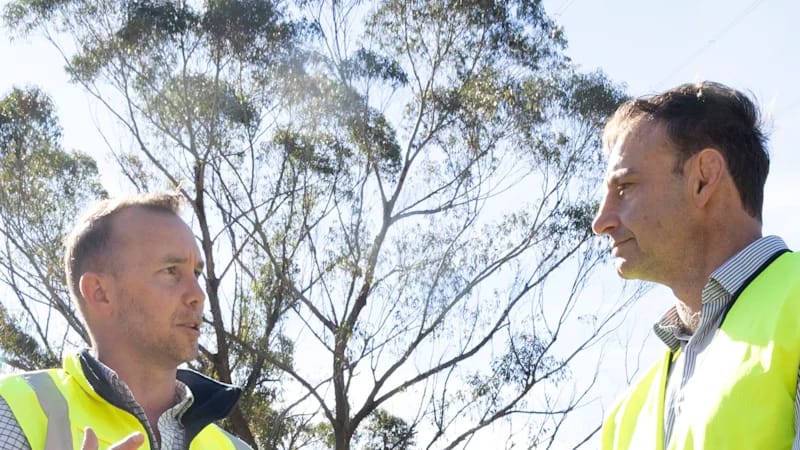
LGI chief executive Jarryd Doran said the power would come from the grid and be bought and sold from and to the national electricity market.
“We will consume electricity or import into the battery when there is surplus energy in the market, and this actually happens almost every day because … there’s plenty of sunshine, there’s plenty of excess energy available,” Doran said.
“A battery system like what we’re proposing for Belrose can help the network by soaking up that surplus electricity, storing it in the battery pack, and then, as the sun goes down or as demand on the network increases, that energy can be released and be provided into the network when it’s most needed.”
LGI has experience operating batteries on sites where it generates electricity from landfill gas, such as Eastern Creek Landfill in western Sydney. However, the battery at the WAMC site in Belrose will be standalone, with LGI buying electricity from the grid and selling it back when needed.
The Belrose site used to have a power station powered by landfill gas but it no longer produces enough gas. WAMC chief executive Peter Graham said this created an opportunity because the site already had the poles and wires for a large-scale connection to the grid.
“With the old electricity generators that were on-site we had an existing connection to the electrical grid, and that connection has been utilised for the battery system itself,” Graham said. “You can just plug the batteries pretty much straight into that same location with both the compound ready to go and the grid connection ready to go.”
Doran said the project was unusual for its size.
“It’s what we often refer to as the missing middle between the households and the large-scale projects,” he said. “There’s literally hundreds of sites like this around Australia where we’ll have the opportunity to look at doing something similar.”
NSW and the ACT have 10 standalone energy storage systems with a total capacity of 2500 MW/71,600 MWh, and six co-located with renewable energy generation with a total capacity of 420 MW/1100 MWh.
Get to the heart of what’s happening with climate change and the environment. Sign up for our fortnightly Environment newsletter.
 Caitlin Fitzsimmons is the environment and climate reporter for The Sydney Morning Herald. She was previously the social affairs reporter and the Money editor.Connect via email.